Lance Banner
The InnocentLance Banner is a Livingston detective whose long history with Matt Hunter complicates his response to Matt’s return after prison. He first appears to enforce the town’s suspicion of a convicted man, but the narrative also shows him questioning whether that suspicion has justified his own conduct.
Identity and Background
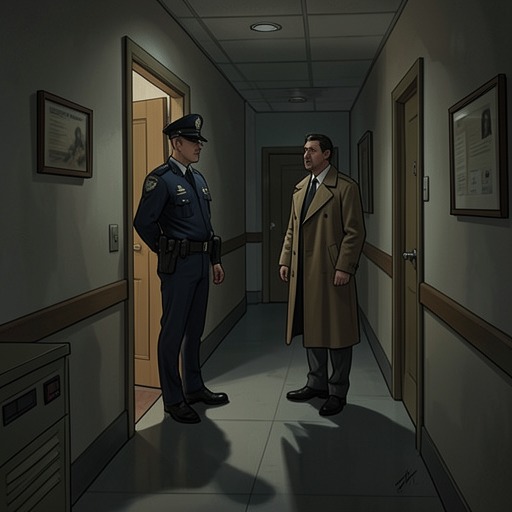
Lance is introduced as a police officer who arrives at Matt’s prospective home with a uniformed colleague. Matt recognizes him from Livingston High, and Lance greets him as an old acquaintance. When Matt addresses him by his first name, Lance answers that he is now Detective Banner, making his professional title part of the boundary he tries to establish between their shared past and their present encounter.
Their history extends back to childhood. Lance remembers Matt as a gentle boy who cried after dropping a fly ball in a Little League game; Matt’s father comforted him, while Lance privately thought he was a big baby. Matt, meanwhile, recalls a second-grade recess game in which Lance’s pants split. The memories are not equivalent in tone, but together they establish a relationship formed long before either man’s adult role: Lance’s recollection emphasizes Matt’s former softness, while Matt’s returns to an embarrassing episode from Lance’s childhood.
Suspicion and the Return of Matt
Lance has read about Matt’s case and contacted police acquaintances to learn its details. His first approach is pointed rather than neutral: he reminds Matt that the boy Matt killed is still dead. The remark makes the town’s defining fact about Matt his conviction and the death behind it, and makes Lance’s old familiarity feel less like welcome than surveillance.
Matt’s return also exposes Lance to his neighbors’ fears. Fellow officers discuss taking action; Lance’s wife, Wendy, objects to a convicted killer moving into the neighborhood; and a town councilman raises the effect on property values. Lance acts amid this pressure, but later admits uncertainty about whether he regrets doing so. His concern is not solely an abstract judgment of Matt: the account shows a local community turning a returning ex-prisoner into a perceived threat, with domestic and civic pressures reinforcing the police response.
Matt experiences Lance as a figure who controls access to the town. In a moment of anger and alcohol-fueled readiness for confrontation, he recalls Lance as the keeper of the Livingston gate and wonders whether prison has changed him into someone more inclined toward violence. That image gives Lance a significance beyond his rank: to Matt, he stands at the threshold between the life Matt hopes to resume and a community that may not accept him.
Work with Loren Muse
Lance also crosses paths with Loren Muse, who is investigating Matt’s circumstances. When Loren visits Matt’s sister-in-law, Lance is waiting by her car. She recognizes him as Detective Lance Banner, and he invites her to get in so they can talk, then drives around the old neighborhood while asking what she wanted with Matt’s family. Their conversation places Lance between Loren’s inquiry and the town’s private life: he is both a local officer and someone with longstanding personal ties to the people under discussion.
Loren asks whether Lance saw early signs of psychosis in Matt. Lance’s answer is a firm no, and his childhood memories support that response: the Matt he recalls was soft, not an obvious early danger. Yet Lance does not treat that history as proof that Matt could never have changed. He rejects the idea that character is settled entirely in early childhood, while adding his bleak belief that change is always for the worse. The exchange reveals both an openness to reconsidering Matt and a pessimism that continues to color his judgment.
Later, Lance approaches the Hunter home with two younger uniformed officers. By then, he is having second thoughts about his previous encounter with Matt. He recognizes that, whatever Matt did in the past or may have become, Matt did not deserve Lance’s clumsy and stupid harassment. Lance even likens his own behavior to intimidating a supposed outsider like a small-town caricature. The admission is a meaningful check on his earlier posture: he does not erase the community’s anxieties, but he acknowledges that he acted badly under their influence.
Investigation and Continuing Contact
Lance’s connection to the investigation becomes practical as well as personal. He tells Loren that he lives close to Matt’s sister-in-law’s house and volunteers to check it himself. The detail links his local residence to police work, while also showing how readily the case draws him into the neighborhood around Matt.
He remains in contact with Loren by phone, introducing himself as her friendly neighborhood Lance and asking her to guess where he is. Elsewhere, he tells Matt that he has heard Matt was looking for him. When Matt asks whether he is a suspect in a crime, Lance describes their exchange as a friendly conversation and raises Sister Mary Rose, a teacher at the school, as a subject of inquiry. The exchange keeps their relationship unsettled: Lance can approach Matt with apparent informality while asking questions that make Matt conscious of the investigation and his vulnerability to suspicion.
At a later point, Lance calls Loren with urgent news: they have lost Matt. He begins to explain that Kyra started screaming, but the available account cuts off before he gives the full circumstances. The call establishes that Lance is involved in the effort to locate Matt and that events around the child have disrupted the search; it does not, by itself, establish what happened next.
Change and Narrative Role
Lance is neither simply Matt’s childhood friend nor merely the detective confronting a convicted man. His position shifts between those identities. He invokes Matt’s past crime, participates in the local response to Matt’s return, and stands in Matt’s imagination as a gatekeeper; yet he remembers the child Matt was, admits that the boy showed no early warning signs, and later recognizes that his own intimidation was unjustified.
That unresolved combination gives Lance a role in the novel’s examination of reintegration and suspicion. The town’s anxiety reaches him through colleagues, family, and civic concerns, but his later self-questioning shows that social pressure does not wholly determine his conduct. His continued work with Loren and contact with Matt keep him inside the investigation, while his reconsideration leaves open whether professional duty and old familiarity can coexist without becoming either harassment or misplaced trust.